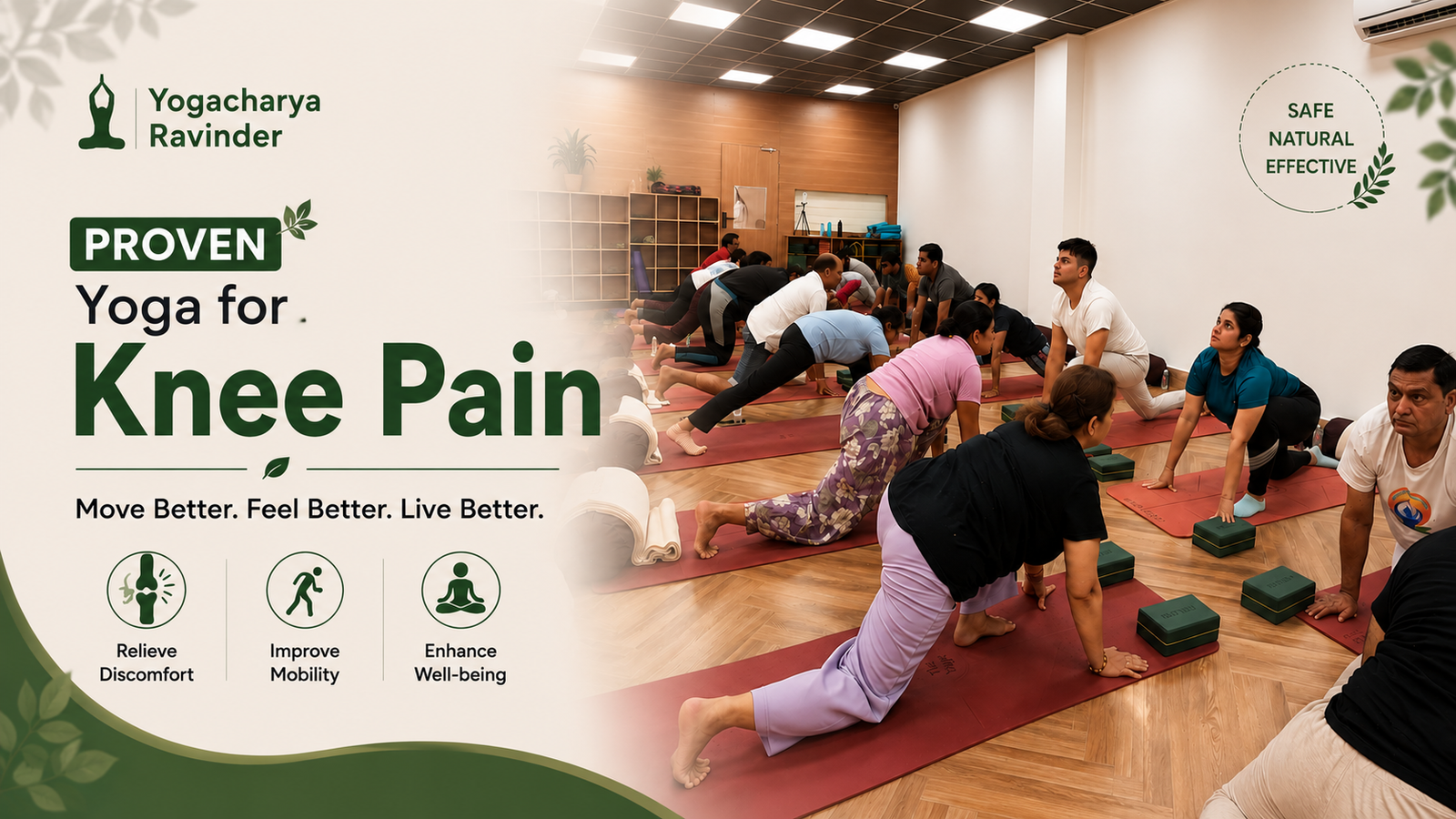
Knee pain is a common problem that can affect people of different ages and activity levels. Simple activities such as walking, climbing stairs, getting up from a chair, sitting on the floor, or exercising can become uncomfortable when the knees feel painful or stiff. For some people, knee discomfort develops gradually because of inactivity, muscle weakness, age-related changes, or repetitive stress. For others, it may occur after an injury or as a result of an underlying joint condition.
Many people therefore look for gentle forms of exercise that can help them stay active without placing unnecessary stress on their knees. Yoga for Knee Pain can be a useful part of a balanced movement routine because yoga combines controlled movement, flexibility, strengthening, balance, breathing, and body awareness. When practiced correctly and modified according to individual needs, these elements may help support healthy movement and overall lower-body function.
However, yoga is not a universal treatment for every type of knee pain. The cause of knee pain is important when deciding which exercises are appropriate. A gentle routine that works well for someone with mild stiffness may not be suitable for someone recovering from an injury or dealing with significant swelling or instability.
The goal of practicing yoga for knee pain should not be to force the knees into deep stretches or challenging postures. Instead, the focus should be on comfortable movement, gradual strengthening, improved flexibility, and developing better awareness of how your body moves.
What Causes Knee Pain?
Knee pain can develop for many different reasons, which is why it is important to understand that not all knee pain should be approached in the same way. Some people experience discomfort after sitting for several hours, while others develop pain after exercise, sports, an injury, or repetitive physical activity.
Common contributors to knee pain include muscle weakness, tightness around the hips and legs, overuse, previous injuries, reduced mobility, inflammation, osteoarthritis, and sudden changes in physical activity. Age-related changes can also affect the knee joint and surrounding tissues.
The knee is part of a larger movement system that includes the hips, ankles, thighs, calves, and feet. Weakness or limited mobility in one area can sometimes affect how the entire lower body moves. This is one reason a well-designed yoga practice should not focus exclusively on stretching the knee itself.
If knee pain is severe, persistent, associated with significant swelling, or occurs after an injury, it is important to seek appropriate professional assessment before starting a new exercise program.
Can Yoga Help With Knee Pain?
For some people, Yoga for Knee Pain may support improvements in mobility, flexibility, strength, balance, and physical function. Yoga provides a low-impact way to practice controlled movement while allowing many poses to be modified according to individual ability.
Research on yoga and knee osteoarthritis has shown potential benefits for pain, stiffness, and physical function, although studies vary in their yoga styles, exercise programs, duration, and participant characteristics. Therefore, the results should not be interpreted as meaning that yoga will eliminate knee pain for everyone.
Instead, yoga can be viewed as one component of a broader approach to healthy movement. A suitable routine may help you remain physically active, strengthen muscles around the lower body, improve flexibility, and become more aware of how you move.
The key is choosing movements that are appropriate for your current level of mobility and avoiding positions that aggravate your symptoms.
How Can Yoga for Knee Pain Support Your Knees?
Yoga May Improve Flexibility
Flexibility in the hips, thighs, hamstrings, and calves can influence how comfortably the lower body moves. When these areas become tight, everyday movements may feel restricted or uncomfortable.
Gentle yoga stretches can help maintain or gradually improve flexibility when performed consistently. However, the goal should be comfortable movement rather than forcing the body into a deep stretch. If you feel sharp or increasing pain around the knee during a stretch, the movement should be reduced or stopped.
Yoga Can Strengthen Supporting Muscles
The knee depends on the surrounding muscles for support during everyday movement. The quadriceps, hamstrings, glutes, calves, and hip muscles all contribute when you walk, climb stairs, stand up, or maintain balance.
Certain yoga poses require these muscles to engage while you control your body weight. Gradually developing strength can support better lower-body function and make everyday movements more manageable.
Strengthening should always be progressive. Someone with knee pain does not need to immediately perform deep squats or demanding standing poses. Modified movements can provide a more appropriate starting point.
Yoga May Support Mobility
Long periods of inactivity can make the body feel stiff. This is particularly common among people who spend much of their day sitting at a desk or working in one position.
Gentle yoga encourages regular movement through comfortable ranges of motion. Moving the hips, ankles, knees, and spine can help you maintain overall mobility and make physical activity feel more accessible.
The objective is not to force maximum movement. Instead, focus on controlled and comfortable movement that can gradually become part of your daily routine.
Yoga Can Improve Balance and Body Awareness
Balance is an important part of healthy movement, especially as people get older. Yoga often includes standing postures that require you to control your body position and distribute your weight carefully.
Practicing balance with appropriate support can improve body awareness and confidence. If you feel unstable, perform standing poses beside a wall or sturdy chair rather than trying to balance without assistance.
Yoga also encourages mindfulness. Paying attention to how your knees, hips, feet, and spine feel during movement can help you identify which exercises are comfortable and which require modification.
Best Yoga Poses for Knee Pain
There is no single yoga pose that is best for everyone with knee pain. The appropriate movements depend on your mobility, symptoms, fitness level, and the underlying cause of your discomfort. The following poses can be considered as gentle options when they feel comfortable.
Mountain Pose
Mountain Pose is a simple standing posture that can help you develop awareness of how you distribute your weight through your feet and legs. Stand comfortably with your feet positioned naturally and avoid aggressively locking your knees.
Lengthen your spine without forcing your chest upward, relax your shoulders, and breathe slowly. As you stand, notice whether you are placing more weight on one leg than the other.
Although this pose looks simple, it can help you become more aware of your standing alignment. This awareness can be useful when practicing other movements and during everyday activities such as walking or standing.
Supported Chair Pose
A modified Chair Pose can help engage the thighs and hips while allowing you to control the amount of knee bending. Stand in front of a stable chair and slowly move your hips backward as though you are preparing to sit down.
Keep the knee bend shallow and use the chair for support if necessary. You do not need to lower your body deeply. The purpose is to practice controlled movement and gradually engage the muscles around the hips and thighs.
If the movement causes knee pain, reduce the range of motion or choose another exercise. Over time, the exercise can be adjusted according to your strength and comfort.
Bridge Pose
Bridge Pose is a useful addition to a lower-body routine because it works primarily through the hips and gluteal muscles while also engaging the posterior chain.
Lie comfortably on your back with your knees bent and your feet placed on the floor. Slowly lift your hips while maintaining control, pause briefly, and then lower yourself back down.
During the movement, avoid allowing the knees to collapse inward. If your knees feel uncomfortable, adjust your foot position or reduce the height of the hip lift.
Seated Leg Extension
Seated leg extensions are particularly useful for beginners because they can be performed on a stable chair without requiring full body weight to pass through the knees.
Sit upright with your feet on the floor. Slowly extend one leg forward and straighten it only as far as comfortable. Pause briefly before returning the leg to the starting position.
The movement should be slow and controlled. You are practicing comfortable knee movement rather than trying to force the leg completely straight.
Supported Tree Pose
Tree Pose can be modified to work on balance and lower-body stability. Stand near a wall or sturdy chair and place one hand on the support.
Shift your weight onto one leg while keeping the other foot lightly supported. Beginners can simply keep the toes of the lifted foot on the floor rather than lifting the entire foot.
Do not place your foot directly against the side of your knee. Keep the position comfortable and switch sides after several breaths.
Cat-Cow
Cat-Cow is primarily a spinal mobility exercise, but it can be included in a gentle full-body yoga routine. Start on your hands and knees if this position is comfortable.
Slowly move between a rounded spine and a gentle extension while coordinating the movement with your breathing. Keep the movement smooth rather than forcing your spine.
If kneeling causes knee discomfort, place a folded blanket underneath your knees or choose a seated alternative. There is no benefit in forcing yourself to remain in a position that aggravates your symptoms.
Gentle Calf Stretch
The calf muscles play an important role in lower-body movement, and maintaining comfortable calf flexibility can support overall mobility.
Stand facing a wall and place your hands against it. Step one foot backward and gently shift your weight forward while keeping the movement comfortable.
Do not force the heel toward the floor. The stretch should feel gentle and controlled rather than painful.
A Beginner-Friendly Yoga Routine for Knee Pain
If you are new to yoga, start with a short routine rather than immediately attempting a long or demanding session. Begin with two to three minutes of comfortable breathing to help you settle into the practice. Follow this with gentle ankle movements and seated leg extensions to gradually introduce movement to the lower body.
Next, practice Mountain Pose for about one minute, focusing on comfortable weight distribution. You can then perform a few repetitions of supported Chair Pose, followed by Bridge Pose if it feels comfortable.
Finish with a gentle calf stretch and a supported balance exercise such as a modified Tree Pose. Spend the final few minutes relaxing and breathing comfortably.
The entire routine can take around 15–20 minutes. As your strength and confidence improve, you can gradually adjust the duration and exercises. Remember that this is a general example rather than an individualized treatment plan.
How Often Should You Practice Yoga for Knee Pain?
Consistency is usually more useful than occasionally performing an intense workout. Beginners can start with short sessions several times per week and gradually adjust the frequency according to their comfort and physical ability.
You do not need to practice yoga for an hour every day to create a consistent movement habit. A short routine performed regularly can be easier to maintain.
Pay attention to how your knees respond during and after each session. If your symptoms consistently become worse after practice, the intensity, exercises, or technique may need to be modified.
Yoga for Knee Pain and Osteoarthritis
Osteoarthritis is one of the common causes of persistent knee discomfort, particularly among older adults. Exercise is often an important part of maintaining mobility and physical function for people with osteoarthritis.
Studies investigating yoga for knee osteoarthritis have reported potential improvements in pain, stiffness, and physical function. However, yoga programs used in research vary, and not every pose will be appropriate for every person with osteoarthritis.
A knee-friendly practice may focus on gentle mobility, strengthening the hips and legs, balance, and flexibility rather than deep knee bending.
If you have been diagnosed with knee osteoarthritis, consider discussing your exercise routine with a healthcare professional or physiotherapist so that the movements can be appropriately adapted.
Can Yoga Help With Knee Stiffness?
Yoga may be particularly useful as a movement practice for people whose knee stiffness is associated with inactivity or spending long periods in one position.
Gentle movements can help you gradually move the lower body through comfortable ranges of motion. Seated leg extensions, ankle movements, supported standing, and gentle hip mobility can be useful starting points for some people.
However, stiffness should not automatically be treated with exercise. If stiffness is accompanied by significant swelling, locking, instability, severe pain, redness, or warmth, it is important to seek professional assessment.
Common Mistakes to Avoid When Practicing Yoga for Knee Pain
One of the biggest mistakes is assuming that deeper poses produce better results. When you have knee discomfort, forcing a deep squat or stretch can put unnecessary stress on the joint. A smaller, controlled movement may be more appropriate.
Another common mistake is ignoring pain. Yoga should challenge your body within a manageable range, but sharp, severe, or worsening joint pain should not be treated as a normal part of the practice.
Beginners may also make the mistake of skipping warm-ups and immediately attempting advanced poses. Starting with gentle movements allows your body to gradually prepare for more demanding positions.
It is also important not to compare your practice with someone else’s. Every person’s flexibility, strength, anatomy, and injury history is different. A pose that feels comfortable for one person may not be suitable for another.
How to Make Yoga Safer for Your Knees
Using yoga props can make a significant difference. A folded blanket can provide additional cushioning under the knees, while a chair or wall can provide stability during standing poses.
You can also reduce the range of motion in almost any movement. You do not need to perform a pose to its deepest position to receive a benefit from practicing controlled movement.
Slow movements are especially helpful when dealing with knee discomfort because they allow you to notice how your body responds. Avoid rushing through transitions or using momentum to move into a pose.
Most importantly, progress gradually. If you have been inactive for a long time, start with a short routine and increase your activity slowly.
Can Yoga Replace Medical Treatment for Knee Pain?
Yoga should not replace medical diagnosis or treatment when knee pain is persistent, severe, or caused by an underlying medical condition.
Knee pain can result from many different problems, and determining the cause is important before deciding which exercises are appropriate.
Depending on the condition, a healthcare professional may recommend physical therapy, strengthening exercises, lifestyle changes, medication, or other forms of treatment.
Yoga can potentially complement an appropriate treatment plan when your healthcare provider considers it suitable.
When Should You See a Doctor or Physiotherapist?
Professional evaluation is especially important when knee pain is severe, persistent, or worsening. You should also seek assessment if the pain began after a significant injury or if you experience considerable swelling, instability, locking, or difficulty bearing weight.
People recovering from knee surgery should follow their rehabilitation plan and receive appropriate guidance before adding new exercises.
Rather than trying to exercise through unexplained pain, finding the underlying cause can help you choose a safer and more effective approach.
Lifestyle Habits That Can Support Healthy Knees
Yoga is only one part of maintaining healthy movement. Staying physically active through appropriate activities can help you maintain strength and mobility.
If you spend several hours sitting, take regular movement breaks whenever possible. Even brief periods of walking or changing positions can help reduce the amount of time you remain completely inactive.
Maintaining a healthy body weight may also be beneficial for people who are carrying excess weight because the knees experience substantial mechanical demands during everyday activities.
Strength training, appropriate walking, comfortable footwear, adequate recovery, and gradual increases in activity can also contribute to a more sustainable approach to knee health.
For more practical guidance on yoga, weight management, flexibility, mobility, and overall wellness, explore our other helpful yoga blogs and discover simple practices that can support your health and fitness journey with Yogacharya Ravindra.
Conclusion
Yoga for Knee Pain can be a useful part of a balanced approach to maintaining flexibility, mobility, strength, balance, and healthy movement. Unlike high-impact activities, a carefully modified yoga routine can provide opportunities to move the lower body while allowing you to control the intensity and range of motion.
The most important part of practicing yoga for knee health is not performing advanced poses. It is learning to move consistently, gradually, and comfortably. Simple movements such as seated leg extensions, supported standing poses, Bridge Pose, gentle stretching, and balance exercises can be incorporated into a beginner-friendly routine when appropriate.
Research also suggests that yoga may provide benefits for some people with knee osteoarthritis, particularly in areas such as pain, stiffness, and physical function. However, individual results vary, and yoga should not be considered a guaranteed treatment for knee problems.
If you experience significant pain, swelling, instability, locking, or symptoms following an injury, professional assessment should come before starting a new exercise routine.
With appropriate modifications and consistent practice, yoga can become a valuable part of a lifestyle focused on maintaining mobility and supporting stronger, healthier movement.
If you want to develop a structured yoga practice for your fitness, flexibility, mobility, and overall wellness goals, Yogacharya Ravindra can guide you toward a consistent approach to yoga.
Frequently Asked Questions
1. Is yoga good for knee pain?
Yoga may help some people with knee pain by supporting flexibility, mobility, strength, balance, and physical function. However, its effectiveness depends on the underlying cause of the pain and the type of yoga being practiced.
2. Which yoga poses are best for knee pain?
Gentle and modified movements such as Mountain Pose, supported Chair Pose, Bridge Pose, seated leg extensions, supported balance exercises, and gentle stretching may be appropriate for some people. The best poses depend on your individual symptoms and physical ability.
3. Can yoga reduce knee pain caused by arthritis?
Research suggests that yoga may help improve pain, stiffness, and physical function in some people with knee osteoarthritis. However, yoga should be considered a complementary exercise approach rather than a replacement for appropriate medical or rehabilitation care.
4. Can I do yoga if my knee hurts?
It depends on why your knee hurts and how severe the symptoms are. If you have mild stiffness, gentle modified movements may be appropriate. If you have severe, unexplained, or worsening pain, seek professional guidance before beginning a new yoga routine.
5. How often should I practice yoga for knee pain?
A short and consistent routine several times a week can be a practical starting point. Begin gradually and adjust your routine according to your comfort, fitness level, and professional recommendations if you have an existing knee condition.